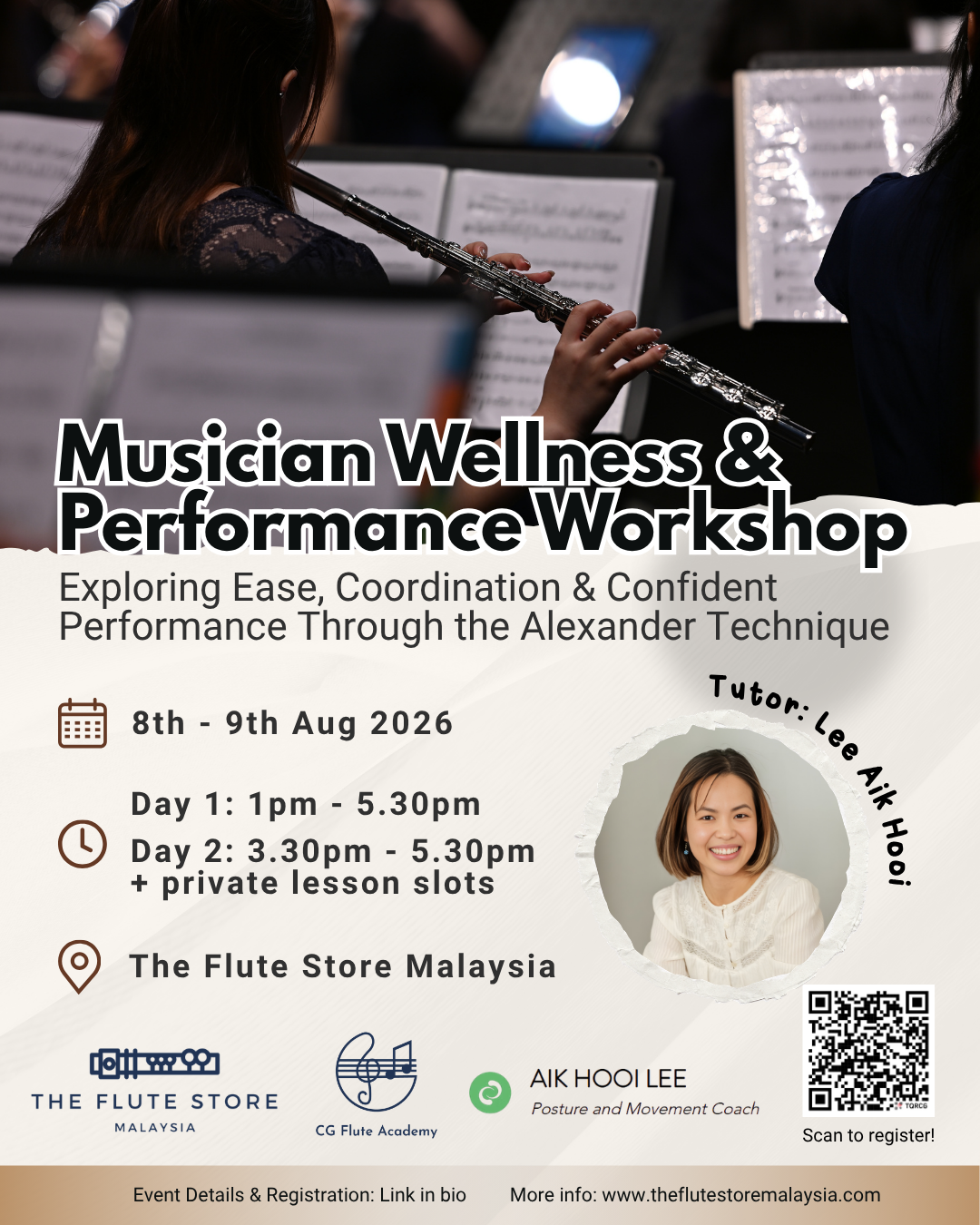
We are excited to invite you to a two-day Musician Wellness & Performance Workshop: Exploring Ease, Coordination & Confident Performance Through the Alexander Technique, led by certified Alexander Technique teacher Aik Hooi Lee.
The Alexander Technique is a mind-body method that helps musicians recognise and release unconscious habits that may interfere with movement, breathing, coordination and performance. Through body awareness, mindful movement and gentle hands-on guidance, participants will explore practical ways to reduce tension, prevent injuries, manage performance anxiety and perform with greater ease and efficiency.
📅 Date: 8–9 August 2026, Saturday and Sunday
📍 Venue: The Flute Store Malaysia, Petaling Jaya
Saturday, 8 August 2026
• Workshop 1: Foundations of the Alexander Technique — 1:00pm–3:00pm
• Tea Break — 3:00pm–3:30pm
• Workshop 2: Anatomy, Movement Coordination & Breath — 3:30pm–5:30pm
• Private lesson slots available
Sunday, 9 August 2026
• Masterclass: Integration & Performance — 2:00pm–4:00pm
• Open to public observers
• Private lesson slots available
Registration and available private lesson slots:
Why join the group workshop?
Participants are strongly encouraged to prioritise the group workshop, as it provides the essential foundation for understanding and applying the Alexander Technique. The group setting allows participants to experience practical exercises, learn through observation and shared exploration, and better understand how posture, breathing, movement and mindset work together in music-making.
Private lessons are most beneficial as an additional opportunity for personalised guidance after attending the workshop, or for those who already have previous Alexander Technique experience.
Workshop Highlights
• Gentle hands-on Alexander Technique guidance
• Practical tools for posture, breathing and performance ease
• Relaxation and awareness exercises for musicians
• Supportive small-group environment
• Opportunities to explore the Technique with your instrument
• Interactive performance masterclass
• Complimentary light refreshments
• Open to students, professionals, educators, adult learners and curious beginners
Pricing
🎉 Exclusive Rates for Friends of TFS/CGFA
• Package A: Workshop + Masterclass Observer — RM350
• Package B: Private Lesson + Masterclass Observer — RM250
• Masterclass Observer Only — RM50
• All-Inclusive Package: Workshop + Private Lesson + Masterclass Observer — RM500
No previous experience is required. Participants may attend the workshop even if they are not professional musicians.
Please wear comfortable clothing and bring your instrument, water bottle, notebook or journal, and yoga mat. Flutists and wind players may also bring excerpts or passages that feel physically or technically challenging.
Hands-on guidance is gentle, optional and fully consensual. Participants with injuries, health conditions or physical limitations are encouraged to provide the relevant information during registration.
Registration and available private lesson slots:
Places are limited to maintain a supportive small-group learning environment. Early registration is encouraged.
About
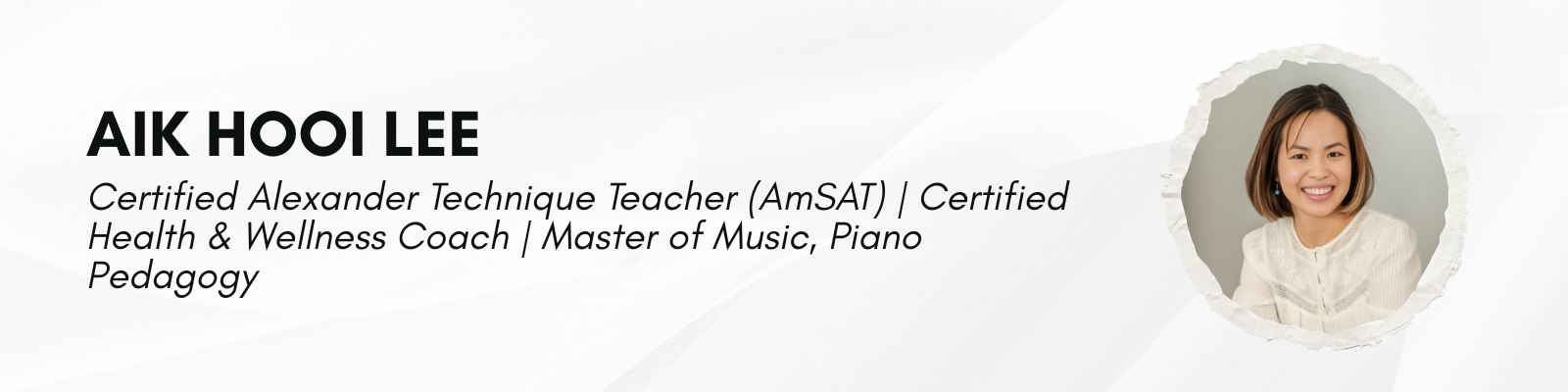
Aik Hooi Lee is the first Malaysian certified teacher of the Alexander Technique through the American Society for the Alexander Technique (AmSAT). She completed a rigorous 1,600-hour, three-year teacher training program at the American Center for the Alexander Technique (ACAT) in New York City—one of the world’s most established training schools.
She holds a Master of Music in Piano Pedagogy from West Virginia University and has over 23 years of piano teaching experience, alongside more than a decade of Alexander Technique practice. In 2025, she expanded her work as a certified Health and Wellness Coach, supporting a more holistic, whole-person approach.
A classically trained pianist and dancer, Aik Hooi discovered the Alexander Technique after a career-threatening repetitive strain injury at age 22. This work not only restored her ability to play but transformed her relationship with her body and performance.
She is now a sought-after educator and workshop facilitator, having taught at institutions including Columbia University, NYU Tisch School of the Arts, Fordham University, The New School, and the Malaysia National Symphony Orchestra, as well as festivals and universities across Asia and the United States.
Aik Hooi specializes in helping performers, musicians, actors, and high-achieving individuals move beyond chronic tension, injury, and performance anxiety—returning to ease, confidence, and freedom. Her work integrates the principles of the Alexander Technique with evidence-informed wellness coaching to create a deeply supportive and sustainable path to wellbeing.
Frequently Asked Questions
Q: What should I bring?
Please wear comfortable, loose-fitting clothing that allows you to move freely and breathe easily. Bring your instrument (if applicable), a water bottle, a small notebook or journal, a yoga mat, and an open mind.
For flutists and wind players, you may also wish to bring any excerpts or passages that feel physically or technically challenging, as they can be useful for exploration during the workshop.
Q: What is the Alexander Technique?
The Alexander Technique is an evidence-based method of mind–body re-education developed in the late 1800s by Frederick Matthias Alexander, an Australian actor who sought to resolve his own chronic vocal and breathing difficulties.
Rather than teaching “correct posture,” the Technique helps you recognize and release unconscious habits of tension that interfere with natural coordination, breathing, and movement. By learning to stop unnecessary effort, greater ease, balance, freedom, and responsiveness can emerge.
For wind instrumentalists and flutists, the Alexander Technique can be especially valuable in addressing:
- Excess tension in the neck, jaw, shoulders, ribs, and hands
- Breathing inefficiencies and over-efforting
- Performance-related stress and anxiety
- Fatigue, pain, and repetitive strain
- Freedom of sound, phrasing, and musical expression
Today, the Alexander Technique is taught at leading conservatories, universities, and medical institutions worldwide, including The Juilliard School, Royal College of Music, Columbia University, and New York University.
Q: Is there anything to prepare ahead of time?
No preparation is required. Simply arrive well-rested and having eaten a light meal beforehand.
You do not need prior experience with the Alexander Technique, anatomy, meditation, or movement work. The workshop is designed to be fully accessible to beginners as well as experienced performers.
If you would like to prepare in a simple way, begin noticing how you breathe, sit, stand, practice, or hold your instrument throughout the day — without trying to “fix” anything. That gentle awareness is more than enough.
Q: Do I need to attend both workshop days?
No. Each workshop day is fully self-contained and may be attended independently.
- Day 1 — Ease in Motion focuses on posture, movement coordination, breathing, and reducing physical tension during playing and daily life.
- Day 2 — Ease in Performance focuses on performance anxiety, stress regulation, stage presence, and performing with greater freedom and confidence.
That said, attending both days is highly recommended. Together, the workshops provide a more complete and integrated understanding of how physical habits, breathing, mindset, and performance are deeply interconnected.
Q: What is the difference between the two workshop days?
Both days are grounded in the same core principles of the Alexander Technique, but each explores a different dimension of music-making.
Day 1 focuses primarily on the physical aspects of playing:
- posture and alignment
- movement efficiency
- breathing coordination
- unnecessary muscular tension
- injury prevention and stamina
This day is especially helpful for flutists and wind players dealing with neck tension, shoulder tightness, jaw gripping, breathing fatigue, or discomfort during long rehearsals and practice sessions.
Day 2 focuses on the psychophysical aspects of performance:
- performance anxiety
- stress responses
- overthinking and self-consciousness
- focus and stage presence
- staying calm and responsive under pressure
Think of Day 1 as developing ease in movement, and Day 2 as developing ease under performance pressure.
Q: I am not a professional musician. Is this workshop still relevant to me?
Absolutely. The workshop is open to musicians of all levels — including students, amateurs, educators, adult learners, and curious beginners.
While many examples will relate specifically to wind playing and flute performance, the principles of the Alexander Technique apply to anyone interested in breathing, posture, coordination, stress reduction, and moving with greater ease in daily life.
Q: I have pain, an injury, or a health condition. Can I still attend?
In most cases, yes. The Alexander Technique is often particularly supportive for people experiencing chronic tension, repetitive strain, breathing difficulties, or recovery from injury.
Please inform Aik Hooi of any significant injuries, medical conditions, pain concerns, or physical limitations when registering so appropriate modifications and individualized guidance can be provided.
The workshop is educational in nature and is not a substitute for medical care.
Q: Will there be hands-on guidance?
Yes. Gentle hands-on guidance is an important part of Alexander Technique teaching.
Aik Hooi may use light, non-invasive contact — typically around the head, neck, shoulders, back, or arms — to help participants experience greater ease, balance, coordination, and freedom of breathing while playing or moving.
All hands-on work is entirely consensual, and participants are always welcome to decline or opt out at any time.
Q: Will there be opportunities to play during the workshop?
Yes. Participants will have opportunities to explore Alexander Technique principles directly with their instruments throughout the workshop.
On Day 2, four pre-selected performers will participate in an extended masterclass format and receive individualized coaching and hands-on guidance while performing.
Observers also benefit greatly from watching and participating in the learning process.
Q: How many participants will be in each workshop?
Workshop enrollment is intentionally kept small to allow for individualized attention, meaningful interaction, and a supportive learning environment.
Specific participant limits will be shared upon registration.
Q: Will there be follow-up support after the workshop?
Yes. Participants who wish to continue exploring the Alexander Technique may work further with Aik Hooi through private lessons, online coaching, group classes, or future workshops offered through Poise & Harmony.
Information about ongoing programs — including Body in Tune, Poise & Harmony’s wellness and Alexander Technique coaching program — will be shared during the workshop.
Registration now at: